


Thrust Ball Bearings
What is Thrust Ball Bearings
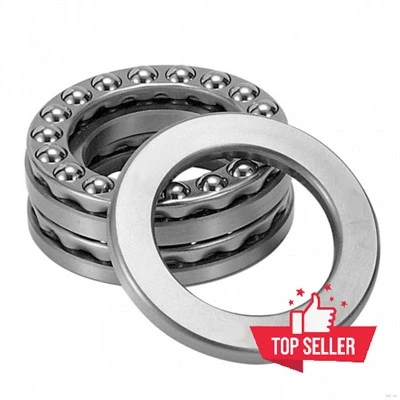
Thrust ball bearings are a unique class of bearing created to support axial stresses. The components of this kind of bearing are a ball in the centre of a cage between two washers. The washer prevents the ball from moving axially while freely rotating inside the cage. Thrust ball bearings are perfect for high axial load applications like turbines and pumps because of their design. Heavy machinery like mining and construction equipment also makes use of them.
Benefits of Thrust Ball Bearings
High Efficiency:Thrust ball bearings have minimal rolling resistance, which translates to high efficiency in axial load support, this efficiency being critical in applications where energy conservation is a concern.
Compact Design:The design of thrust ball bearings is inherently compact, making them ideal for applications with limited space, as they can handle substantial axial loads while taking up relatively little space.
High-Speed Capabilities:Thrust ball bearings are well-suited for high-speed applications thanks to their low friction and efficient design, ensuring stable and reliable operation even at elevated rotational speeds.
Ease of Assembly:Thrust ball bearings are typically easy to install and require minimal maintenance, reducing downtime and operational costs.
Versatility:These bearings are suitable for both unidirectional and bidirectional axial loads, providing flexibility in design and application.


Why Choose Us
Advanced equipment
We take strong measures to ensure that we use the highest quality equipment in the industry and that our equipment is regularly and meticulously maintained.
Professional team
We have a team of highly skilled and experienced professionals who are well-versed in the latest technologies and industry standards. Our team is dedicated to ensuring our customers receive the best service and support.
Competitive price
We offer our products at competitive prices making them affordable to our customers. We believe high-quality products should not come at a premium, and we strive to make our products accessible to everyone.
Quality assurance
In terms of quality assurance, the company strictly follows the standards and specifications of the industry quality system. Use industry-leading testing equipment to ensure product quality and good reputation.
Professional service
We can accept factory inspection and cargo inspection at any time. Technical seminars, new product research and development, and perfect after-sales service.
High quality product
We always put the needs and expectations of our customers first, strive for excellence, continue to improve, seek every opportunity to do better, provide customers with the high-quality products they expect, and provide customers with the most satisfactory services at any time.
Types of Thrust Ball Bearings
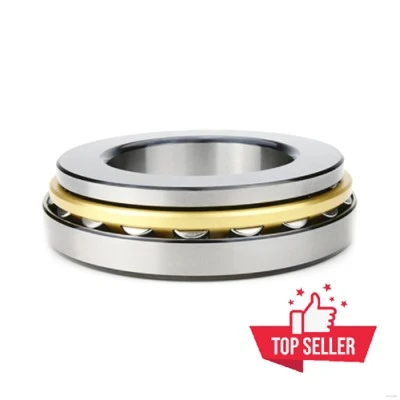
Cylindrical thrust roller bearings
These are small cylindrical rollers. They are aligned with their axes pointing towards the bearing’s axis. These are economical and can carry good capacity. However the friction in these bearings is high.
Tapered roller thrust bearings
There are small tapered rollers aligned in a way that all their axes converge with the axis of the bearing. The length, angle and diameter of the rollers need to be carefully calculated for smooth operation without skidding. However, these are more expensive to manufacture.
Spherical roller thrust bearings
The design uses asymmetrical spherical rollers of spherical shape, that are housed inside a washer with a spherical shaped inner raceway. These are capable of combined radial and axial loads and can manage the misalignment of shafts. This is why this variant offers the highest load density.
Needle roller thrust bearings
These are preferred in cases where a thrust bearing needs minimal height with a high number of rolling elements. Sometimes they are installed without a shaft or washer and can accommodate very high axial and shock loads.
Fluid film thrust bearings
The axial thrust is borne by a thin but flexible layer of pressurized liquid, which ensures low drag for high speed operations.
Magnetic thrust bearings
Just like the fluid bearings mechanism, here the axial thrust is borne on a magnetic field. Highly suited for operations needing very high speeds or low drag.
Applications of Thrust Ball Bearings
Automotive industry
Thrust ball bearings are commonly used in automotive applications such as steering systems, wheel hubs, and transmissions.
In steering systems, thrust ball bearings are used to support the axial load generated by the steering mechanism.
In wheel hubs, they are used to support the axial load generated by the weight of the vehicle and the forces generated during cornering.
In transmissions, they are used to support the axial load generated by the gears.
Aerospace industry
Thrust ball bearings are used in various aerospace applications such as landing gear, thrust reversers, and engine mounts.
In landing gear, thrust ball bearings are used to support the axial load generated by the weight of the aircraft during landing and takeoff.
In thrust reversers, they are used to support the axial load generated by the reverse thrust.
In engine mounts, they are used to support the axial load generated by the weight of the engine.
Machine tools and equipment
Thrust ball bearings are commonly used in machine tools and equipment such as milling machines, lathes, and grinders.
In milling machines, thrust ball bearings are used to support the axial load generated by the cutting tool.
In lathes, they are used to support the axial load generated by the workpiece. In grinders, they are used to support the axial load generated by the grinding wheel.
Differences Between Thrust Ball Bearings and Other Types of Bearings
Radial bearings vs. thrust bearings
Radial bearings are designed to handle radial loads, which are forces that act perpendicular to the axis of rotation.
They are used in applications where the load is primarily radial, such as in electric motors and pumps.
Thrust bearings, on the other hand, are designed to handle axial loads and are used in applications where the load is primarily axial, such as in automotive steering systems and gearboxes.
Thrust ball bearings vs. thrust roller bearings
Thrust ball bearings use balls to handle axial loads, while thrust roller bearings use rollers.
Thrust ball bearings are typically used in applications where the load is relatively light and the bearing size is limited, such as in certain types of pumps and gearboxes.
Thrust roller bearings are used in applications where the load is heavier and the bearing size can be larger, such as in certain types of heavy machinery.

Maintenance of Thrust Ball Bearings
Keep the bearing clean
Dirt and debris can cause premature wear and failure of the bearing. Clean the bearing regularly using a soft cloth or brush and a mild solvent.
Lubricate the bearing
Proper lubrication can reduce friction and wear, and extend the life of the bearing.
Check for wear
Regularly inspect the bearing for signs of wear, such as discoloration, pitting, or cracks. Replace the bearing if any signs of wear are detected.
Proper installation
Ensure that the bearing is properly installed, with the correct fit and clearance, and that the shaft and housing are aligned properly.
Check for accuracy
Thrust ball bearings can support axial loads in one or two directions. The balls, which roll with very low friction and carry the load, transfer the load between the raceways. Due to their design, thrust ball bearings are not appropriate for heavy radial loads.
To ensure appropriate functioning and precise load support, it is important to choose the right size and type of linear bearings and rails south Africa for your application. The bearing also needs to sustain the required speed and load capacity.
Selecting needle bearings that fit your unique requirements is important since thrust ball bearings are made to offer a high level of precision and accuracy. High-precision thrust ball bearings will perform more consistently and deliver successful results.
Speed
Needle bearings are designed to perform well over a specific range of speeds. A fast-moving system will require different bearings than a slow-moving system. Even if they are slightly out of alignment, high-speed bearings must continue to function securely because this might have a far more substantial impact when turning quickly.
Temperature
To make the most of a spinning system, you must know how temperature changes affect its parts. A system's journal bearing can generate a lot of heat, and how they respond to heat from other sources is also essential. The bearing's lubrication needs to be adjusted for the temperatures it will operate.
Load
The bearing load can be measured in several ways. The right radial load angle is applied to the shaft. Forces that act in the same direction can be measured using axial load. In a system, axial and radial loads can combine to create a moment or combined load. A bearing over the expected range must support all three types of loads.
The Design of Thrust Ball Bearings
Thrust ball bearings, as the name suggests, consist of ball bearings arranged in a circular raceway. The balls are positioned between two washers, with one washer being fixed in place, while the other rotates along with the shaft. This design allows the balls to roll along the raceway, enabling smooth axial motion. Additionally, the direction of thrust load transmission is in a straight line, which makes thrust ball bearings ideal for applications with pure axial forces.
Thrust ball bearings generally use steel as the main material, but not all steels are suitable. This kind of mechanical hardware accessories are generally made of bearing steel, because this is more ideal.
Bearing steel has high and uniform hardness and wear resistance, as well as a high elastic limit. The uniformity of the chemical composition of the bearing steel, the content and distribution of non-metallic inclusions, and the distribution of carbides are very strict. It is one of the most stringent steel types in all steel production, and it is also commonly used in thrust ball bearings. a material.Thrust ball bearing is a separable bearing, the shaft ring and seat ring can be separated from the cage and steel ball assembly. The shaft ring is a ring matching the shaft, and the seat ring is a ring matching the bearing seat hole, and there is a gap between the shaft and the shaft; thrust ball bearings can only bear axial loads, and one-way thrust ball bearings can only bear axial loads. For the axial load in one direction, the two-way thrust ball bearing can bear the axial load in two directions; the thrust ball bearing cannot limit the radial displacement of the shaft, and the limit speed is very low, and the one-way thrust ball bearing can limit one of the shaft and the housing Axial displacement in one direction, two-way bearings can limit axial displacement in two directions. Thrust roller bearings are used to bear axial and radial combined loads dominated by axial loads, but the radial load must not exceed 55% of the axial load. Compared with other thrust roller bearings, this kind of bearing has a lower friction coefficient, higher speed and self-aligning performance.
Thrust ball bearings are an important component used in many different types of machinery and equipment. These bearings are designed to handle a specific type of load, known as axial load. Axial loads are forces that act in a straight line, either horizontally or vertically, and are applied along the axis of rotation or movement.
Thrust ball bearings are able to handle both thrust and radial loads, although their primary function is to handle thrust loads. These bearings are designed to be able to withstand the large axial forces that are generated when a machine or equipment operates under heavy loads or high speeds. They are commonly used in applications where high precision and high reliability are required, such as in machine tools, industrial machinery and equipment, and mechanical power transmission systems.
Thrust ball bearings are typically made from high-quality materials, such as high-quality steel, which provides maximum strength and durability. They are designed to be able to withstand high-speed rotations, which can generate large amounts of heat and friction. To ensure that they are able to operate at peak performance, they are often precision-ground to very tight tolerances.
The load capacity of a thrust ball bearing depends on several factors, including the size of the bearing, the number and size of the balls, and the material used to make the bearing. Generally, larger bearings with more balls are able to handle higher loads. The load capacity of a bearing can also be increased by using materials that have a higher strength-to-weight ratio, such as ceramics.
One of the key advantages of thrust ball bearings is their ability to handle both thrust and radial loads, which makes them highly versatile and adaptable to a wide range of applications. They are also relatively low-maintenance, requiring only periodic lubrication to maintain their performance.
Thrust ball bearings are an essential component of many different types of machinery and equipment. They are designed to be able to handle large axial loads and are highly versatile, adaptable, and reliable. With their ability to operate at high speeds while maintaining optimal performance, they are an important part of many critical industrial applications.
Our Factory
Lasting Bearing Group Co., Limited founded in 2008, is a company specializing in the manufacturing and sales of bearing transmission parts. Located in Hong Kong, and we have set up offices in some parts of the world, we are committed to providing our customers with high quality bearing products and high quality service. Since its establishment, the company has been adhering to the product quality and quality service as the center of the business philosophy, gradually become a leader in the industry.

